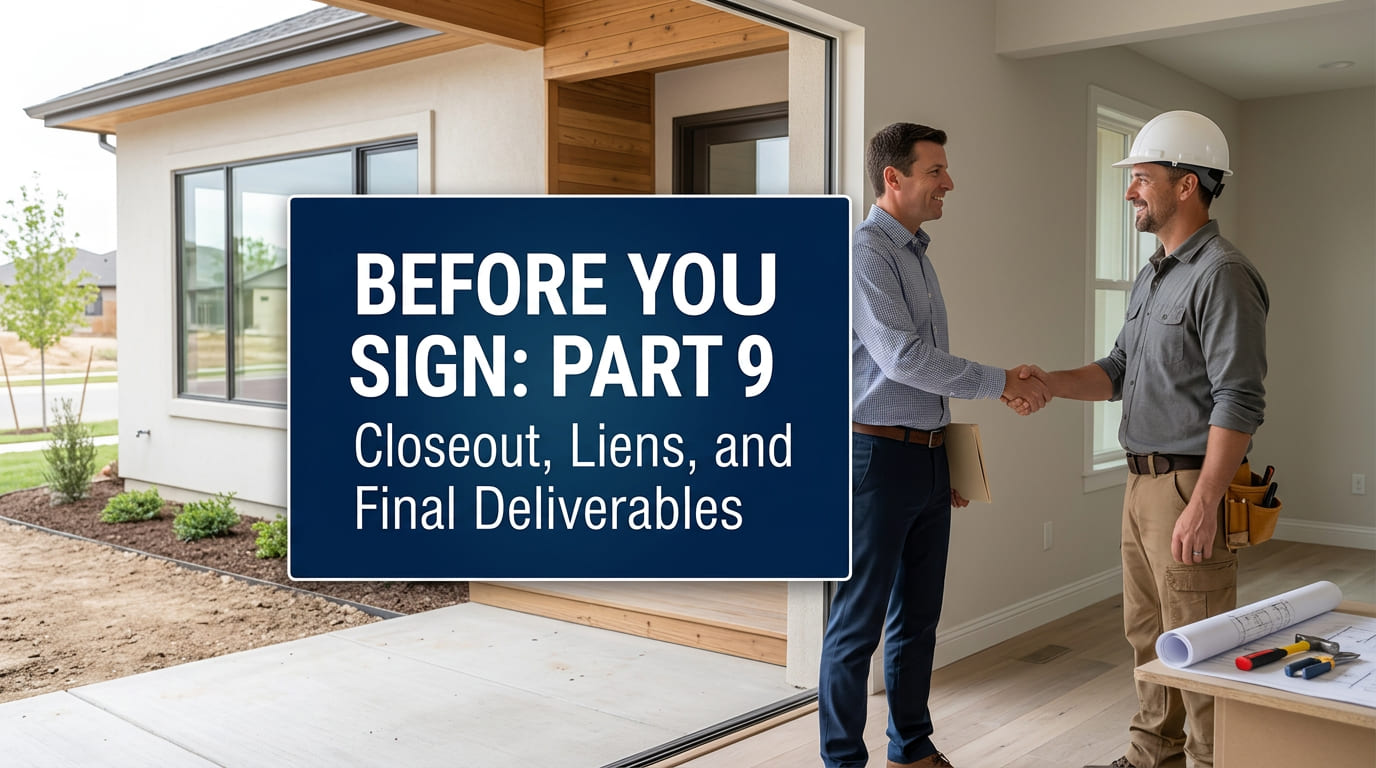
Contract Closeout, Liens, and Final Deliverables — The Job Isn’t Done Until the Paperwork Is
What does contract closeout ensure? The short answer is protection. Construction crews pack up. Their tools disappear. Your contractor hands you a final invoice and tells you the job is done. Is it?
Substantial completion — the point where a project is finished enough for its intended use — is not the same as final completion. And final completion is not the same as being fully protected. There’s a gap between “the work looks done” and “you are legally, financially, and documentarily in the clear.” That gap is what the contract closeout section of your agreement is designed to close.
Most people pay the final invoice and move on. Some of them regret it six months later when a lien shows up on their title, a warranty claim gets denied, or they realize they never received the documents they’re now desperately looking for.
This is the last post in the Before You Sign series — and it covers the part of the project that happens after most people stop paying attention. Don’t stop paying attention.
What Contract Closeout Actually Means
Closeout is the formal process of wrapping up a construction project. It’s not a single moment — it’s a checklist. And like most checklists, it only works if someone is actually following it. Who completes and signs a contract checklist? Read on.
A complete closeout typically involves:
- Completion of all punch list items — the final list of unfinished or deficient work identified at substantial completion
- Final inspections and certificate of occupancy, where required by the permit
- Collection of all closeout documents — warranties, manuals, as-built drawings, certifications
- Execution of lien waivers from the contractor and all subcontractors
- Release of final payment
The sequence matters. Final payment should follow contract closeout — not precede it. Once that last check clears, your leverage to obtain anything outstanding drops to near zero.
The Punch List — Small Items With Big Consequences
A punch list is the written record of items that need to be corrected, completed, or touched up before the project is considered finally complete. Scratched flooring. A door that doesn’t latch properly. Paint touch-ups. A missing cover plate. Individually minor. Collectively, the difference between a finished project and one that nags at you for years.
The punch list should be prepared jointly — a walkthrough with the contractor where both parties agree on what’s outstanding. Get it in writing. Date it. Both “authorized” parties should sign it or confirm it by email.
Your contract should define a reasonable timeframe for the contractor to complete punch list items after substantial completion — typically 30 days, sometimes less. It should also define what happens to the final payment retention if punch list items aren’t completed within that window.
One practical note: don’t let the perfect be the enemy of the good. A punch list is for legitimate deficiencies — not an opportunity to add new scope or debate decisions made during construction. Contractors are entitled to be paid for work they’ve properly completed. Keep the punch list focused on what was agreed to and what isn’t right yet.
A Real-World Example: The Lien That Appeared After the Final Payment
A homeowner completed a kitchen and master bath remodel. The work was solid, the relationship with the contractor was good, and the final payment was made promptly when the job finished. Everyone shook hands and parted ways.
Four months later, the homeowner received notice that a mechanics lien had been filed against their property by a tile subcontractor — one they had never met or spoken to. The subcontractor claimed the general contractor (GC) had never paid them for the tile work despite receiving the owner’s final payment.
The lien clouded the title. The homeowner was in the middle of a refinance. Everything stopped. Resolving the lien — even though the homeowner had paid the contractor in full — required legal fees, negotiation with the subcontractor, and months of delay.
A final lien waiver from the prime contractor and all major subcontractors, collected before the final payment, would have prevented every bit of this.
Mechanics Liens — What They Are and Why They May Be Your Problem
A mechanics lien (sometimes called a materialman’s lien or construction lien) is a legal claim filed against your property by a contractor, subcontractor, or supplier who hasn’t been paid for work or materials provided to your project. It attaches to your title — not to the contractor’s finances — which means it becomes your problem even if you’ve already paid the general contractor in full.
That’s the part most homeowners don’t know until it’s too late. Paying your GC doesn’t automatically mean the subcontractors and suppliers downstream have been paid. If the GC pockets your money and doesn’t pay their subs, those subs can — and often do — come after your property.
Lien laws vary significantly by state. Most states have strict deadlines for filing and enforcing liens, and specific notice requirements that must be met. Hawaii has its own lien statute with particular requirements worth understanding if you’re doing work there. Your contract should reference compliance with applicable lien laws and require standard lien waivers at each payment.
Lien Waivers — Your Primary Defense
A lien waiver is a document signed by the contractor, subcontractor, or supplier waiving their right to file a lien against your property — in exchange for payment. There are two types that matter:
Conditional lien waivers
These waive lien rights conditional on the payment actually clearing. The waiver is signed at the time of payment but only becomes effective once the funds are confirmed. This protects the contractor if a check bounces — and protects you because the waiver is in hand. Conditional waivers are best practice for progress payments throughout the project.
Unconditional lien waivers
These waive lien rights outright — no conditions. They’re appropriate for final payment once you’ve confirmed the funds have cleared. An unconditional final lien waiver from the general contractor and all major subcontractors is your clean bill of health at project closeout.
Your contract should require lien waivers as a condition of each progress payment and as a condition of final payment. Don’t wait until closeout to start collecting them — build it into every payment.
Contract Closeout Documents — What You Should Walk Away With
Beyond lien waivers, a complete construction project produces a set of documents you’ll need long after the crews are gone. Your contract should require delivery of these as a condition of final payment:
- Warranties: Manufacturer warranties on equipment, appliances, roofing, windows, and other systems — plus any contractor workmanship warranty. Know what’s covered, for how long, and what voids it.
- Operations and maintenance manuals: For mechanical, electrical, and plumbing systems. You’ll want these when something needs service and the original installer is long gone.
- As-built drawings: Drawings that reflect the project as actually constructed — including any field changes made during construction. Critical if you ever do future work, need to locate utilities, or apply for permits on the same property.
- Final permit sign-offs and certificate of occupancy: Confirmation that all required inspections have been completed and the work has been approved by the relevant authorities. Without this, a permitted project is technically incomplete.
- Subcontractor and supplier contact list: Who installed what and how do you reach them. You’ll want this when the HVAC system needs service in year three and you can’t remember who put it in.
These documents are easy to promise and easy to forget. Making their delivery an explicit contractual condition — tied to final payment — is the only reliable way to ensure you actually receive them.
What Good Looks Like
A defined closeout process in the contract
Not just “contractor shall provide closeout documents upon completion.” A specific list of required deliverables, a defined timeframe for delivery, and an explicit condition that final payment is withheld until all items are received.
Lien waivers collected at every payment request
Conditional waivers with each progress payment. Unconditional final waivers — from the GC and all major subcontractors — before the last check is written. Don’t skip this step on any project, regardless of how smooth the working relationship has been.
A joint punch list walkthrough
Walk the project with the contractor. Write it down together. Set a completion deadline. This conversation is far easier to have before final payment than after.
Permit closeout confirmed before final payment
If the project required permits, confirm that all final inspections have been passed and the permit is closed before releasing the final payment. An open permit can affect your title, your insurance, and any future work on the property.
Red Flags to Watch For
- Contractor requests final payment before punch list is complete — “we’ll come back for the small stuff”
- No lien waivers provided at progress payments — you’re building up lien exposure with every payment request
- Contractor is unfamiliar with lien waiver requirements or resistant to providing them
- No closeout document list in the contract — warranties and manuals are an afterthought
- Permits are still open at the time final payment is requested
- As-built drawings are not part of the contractor’s standard deliverables — especially concerning for complex mechanical or structural projects
The Takeaway — And the End of the Series
Contract closeout is the last mile of a construction project. It’s unglamorous, detail-oriented, and easy to rush through when everyone is tired and ready to be done. That’s exactly when mistakes happen.
Pay attention to the finish. Collect your lien waivers. Walk your punch list. Don’t release your final payment until the documents are in hand and the permits are closed. The project isn’t done until the paperwork says it is.
That’s true of closeout. And in a lot of ways, it’s true of the whole series.
Construction contracts aren’t exciting reading. But they’re the document that governs one of the largest financial commitments most homeowners and small business owners will ever make. Understanding what’s in them — before you sign — is one of the highest-value things you can do for your project, your budget, and your peace of mind.
That’s what this series has been about. Not to make you a contract attorney. Just to make you a more informed, more protected owner who knows what questions to ask and what to watch for.
If you made it through the whole Before You Sign Series, consider yourself officially graduated from Construction Contracts 101.
Contracts are just the first step, though. Whenever you’re ready to tackle the actual messy, everyday reality of managing your contractor, the rest of the site is right here waiting for you. Take a look around, use what you need, and go build your protect with total confidence.
Previous in the series: Indemnification, Termination and Dispute Resolution — The Exit Clauses That Save Your Project.
This is the final post in the Before You Sign series — a nine-part guide to construction contracts for homeowners, startups, and small businesses. Read the full series from the beginning.