Your Contractor Is Behind Schedule. What Does Your Contract Actually Say?
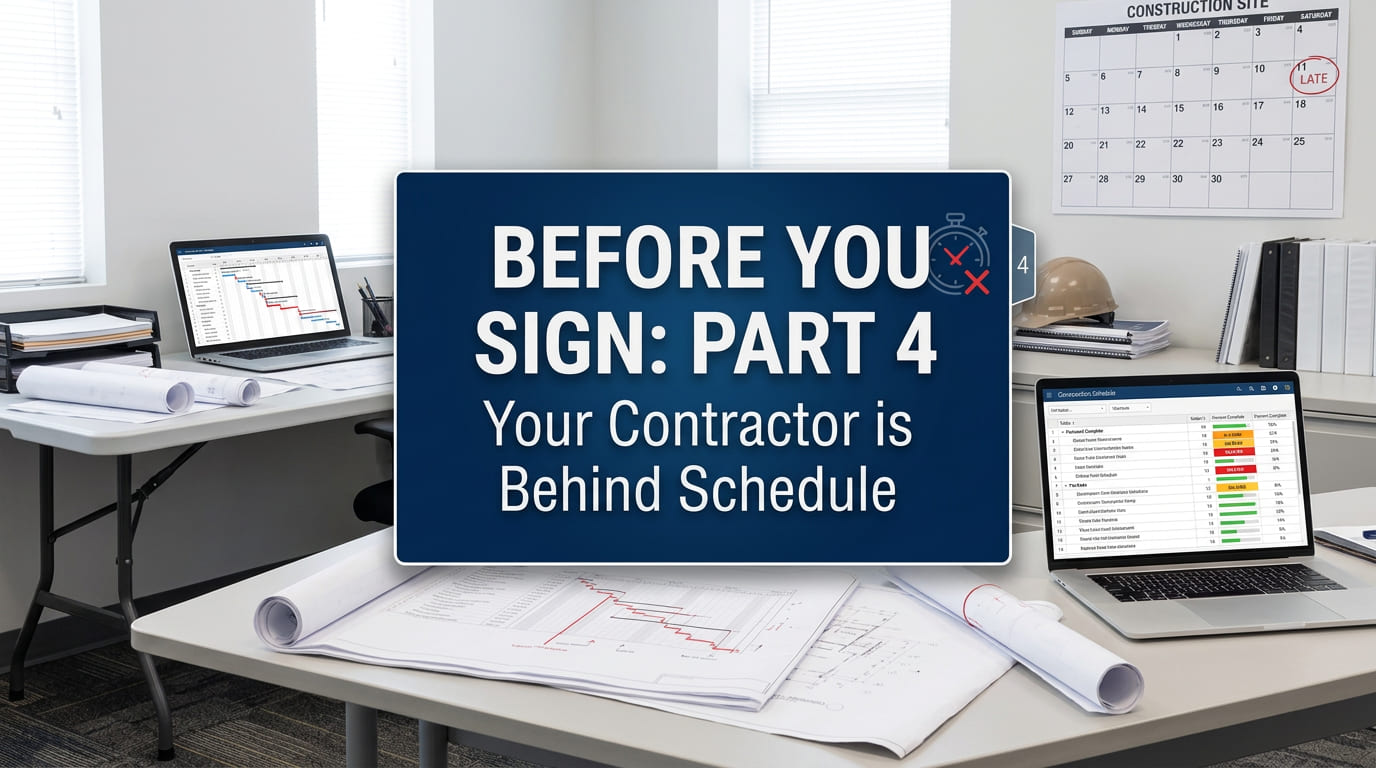
Reality — your contractor is behind schedule — what your contractor says is “We’re running a little behind.”
Five words that every homeowner and small business owner has heard at some point during a construction project. Sometimes it’s a minor inconvenience. Periodically it cascades — a delayed finish date pushes your move-in, your business opening, your lease renewal, your holiday gathering. More times than not, it costs real money.
Here’s the hard truth: whether a contractor’s delay is your problem, their problem, or a shared problem depends almost entirely on what your contract says. And most residential and small commercial contracts say very little about schedule.
That’s a gap worth closing before you sign.
What a Schedule Section Should Actually Cover
A schedule section in a construction contract isn’t just a start date and an end date. Done right, it establishes a framework for how time is managed across the entire project. At minimum, it should address:
- Contract start date — when the contractor is obligated to begin work
- Substantial completion date — when the project is complete enough for its intended use, even if minor punch list items remain
- Milestone dates — for longer projects, intermediate checkpoints that allow both parties to catch drift early
- Delay notification requirements — how quickly the contractor must inform you if they anticipate falling behind, and how
- Excusable delay provisions — circumstances outside the contractor’s control that justify an extension
That last item — excusable delays — is where most of the complexity lives.
Excusable vs. Inexcusable Delays
Not all delays are created equal. Construction contracts typically distinguish between delays that are the contractor’s fault and delays caused by circumstances beyond anyone’s reasonable control.
Excusable delays
These are delays the contract explicitly forgives — meaning the contractor gets a schedule extension without penalty. Common examples include severe weather, material shortages beyond the contractor’s control, permitting delays caused by the city, or work stoppages ordered by a government authority. If a hurricane shuts down a jobsite for two weeks, that’s not the contractor’s failure.
Inexcusable delays
These are delays caused by the contractor’s own actions — or inactions. Poor scheduling, inadequate crew, slow subcontractor management, or simply taking on more work than they can handle. These delays don’t earn an extension. They may entitle you to remedies — if your contract says so.
Owner-caused delays
Here’s the one owners don’t always think about. If you’re late providing information, slow on approvals, or you change your mind mid-project, you’ve caused a delay. A good contract addresses this too — because those delays can become the contractor’s justification for a schedule extension and additional costs.
A Real-World Example: The Restaurant That Opened Late
A restaurant owner contracted for a full interior build-out with a promised completion date of October 1 — giving her four weeks before her planned November 1 soft opening. The contractor finished November 18.
She missed her soft opening. She lost her Thanksgiving revenue window. Her pre-opening marketing — already paid for — ran against a closed storefront. The total loss was estimated at over $60,000.
Her contract had a completion date. It had no delay notification requirement, no milestone schedule, and no remedy for late delivery. The contractor apologized. That was it.
Two contract clauses would have changed everything: a liquidated damages provision and a milestone schedule with required notifications.
Liquidated Damages: The Clause That Creates Accountability
Liquidated damages (LD) is a contract provision that sets a predetermined daily dollar amount the contractor owes for each day the project runs past the completion date. It’s not a penalty — it’s an agreed-upon estimate of the cost of delay, set in advance when both parties are thinking clearly.
For homeowners, a modest LD might look like $200–$500 per day. For a commercial tenant with a business opening on the line, it could be several thousand dollars per day. The number should reflect your actual anticipated losses — temporary housing costs, extended lease payments, lost revenue, that kind of thing.
Contractors push back on liquidated damages. That’s normal. But a contractor who refuses to accept any schedule accountability is telling you something worth knowing before you sign.
One important note: LD provisions cut both ways in well-negotiated contracts. A contractor may ask for a bonus clause — an early completion incentive if they finish ahead of schedule. That’s a reasonable ask, and it aligns everyone’s interests in getting the job done.
What Good Looks Like
A real completion date — not “approximately”
“Approximately 12 weeks from start” is not a completion date. It’s a suggestion. Your contract should have a calendar date for substantial completion. If the start date is conditional on permits or other approvals, the contract should say how the completion date adjusts — and by how much.
A milestone schedule for longer projects
On any project running longer than 60 days, ask for milestone dates tied to measurable events: foundation complete, framing complete, rough-in inspections passed, drywall complete. Milestones let you catch schedule drift early, when it’s still recoverable, rather than discovering a six-week delay in the final month.
A written delay notification requirement
The contract should require the contractor to notify you in writing within a defined window — typically 5 to 10 days — if they anticipate a delay and why. This creates a paper trail and prevents “we mentioned it on the jobsite” from becoming the contractor’s defense.
Defined excusable delay categories
What counts as an excusable delay should be listed — not left to interpretation. “Acts of God” is a common but vague catch-all. Specifics are better: named weather thresholds, government-ordered shutdowns, documented material lead time issues.
Red Flags to Watch For
- No completion date — only an estimated duration with no calendar anchor
- No delay notification requirement — you find out about schedule problems when you visit the jobsite
- Excusable delay language is so broad it covers almost any circumstance — including the contractor being busy
- The contractor refuses any liquidated damages clause and offers no alternative schedule accountability
- No milestone schedule on a project longer than 60 days
- The contract doesn’t address what happens if you cause a delay — that asymmetry usually favors the contractor
The Takeaway
Time is money on a construction project — for both sides. A schedule section that only names a start and end date isn’t managing time. It’s just documenting optimism.
If your project has a hard deadline — a business opening, a lease end date, a family event, a school start date — that deadline needs to be in the contract with teeth behind it. Not as a wish. As a term.
Ask before you sign: what happens if this project runs late? The answer to that question — or the absence of one — tells you a great deal about the contract you’re about to sign.
Previous in the series: The Construction Scope of Work: The Most Abused Section in Any Contract.
Up next in the series: How to Pay a Contractor Without Getting Burned — Payment Terms Explained.
This post is part of the Before You Sign series — a nine-part guide to construction contracts for homeowners, startups, and small businesses. See the full series.