Jobsite Safety: What it is and Who is Responsible

Jobsite safety affects everyone connected to a construction project, not just the crew doing the physical work. Owners, design professionals, and contractors each carry a piece of the responsibility, even when only one signs a construction contract.
Understanding who is accountable for what protects workers, limits liability, and helps a project stay on schedule. This guide breaks down jobsite safety requirements, ratings, and shared responsibilities in plain language.
Why Jobsite Safety Matters
Construction remains one of the most dangerous industries to work in, year after year. The Bureau of Labor Statistics recorded 5,070 fatal work injuries nationwide in 2024. Construction workers accounted for roughly one in five of those deaths, more than almost any other industry.
Falls, being struck by objects, electrocution, and getting caught in or between equipment cause most construction fatalities. OSHA calls these four hazards the “Fatal Four.” Together, they are responsible for more than half of all construction worker deaths each year.
- Falls: the single largest cause of construction deaths, responsible for roughly one in three every year
- Struck-by incidents: workers hit by falling tools, swinging materials, or moving equipment
- Electrocutions: contact with live wires, overhead power lines, or damaged power tools
- Caught-in or caught-between: workers trapped by collapsing trenches, unguarded machinery, or shifting materials
These numbers only count fatalities. Nonfatal injuries are far more common and still carry real costs. A single injury can trigger workers’ compensation claims, OSHA fines, and weeks of lost productivity on a project.
Common Jobsite Safety Hazards
Every jobsite carries hazards, but a handful of conditions cause most injuries and OSHA violations. Recognizing them helps an owner spot warning signs during a site visit, even without construction training.
- Scaffolding: unstable platforms, missing guardrails, or decks overloaded with materials
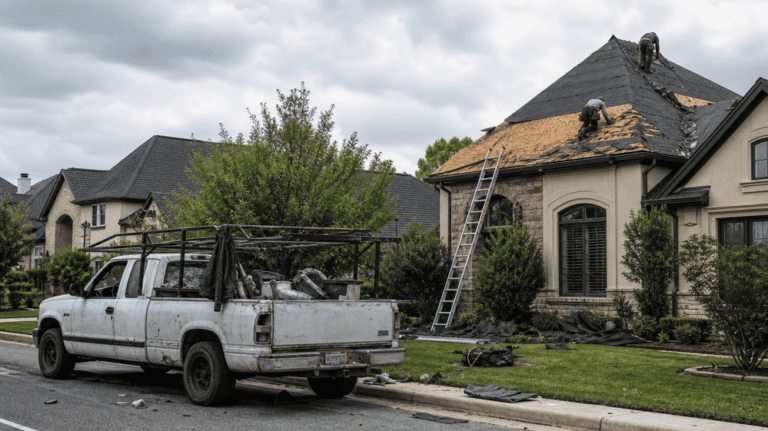
- Ladders: the wrong ladder for the height needed, damaged rungs, or an improper setup angle
- Power cords: frayed cords, cords running through walkways, or cords without ground-fault protection
- Fall protection: missing harnesses, guardrails, or netting near roof edges and floor openings
- Open trenches: unprotected excavations that can collapse without warning
- Respiratory and eye protection: missing masks or goggles during cutting, sanding, welding or chemical work
Ground-fault protection is a safety device that shuts off electrical power automatically if current leaks somewhere it should not. It is one of the most commonly cited missing items on residential and commercial jobsites alike.
Does OSHA Apply to Every Construction Project?
OSHA requirements apply to nearly every construction project, regardless of size or type. There are only a few narrow exceptions. Self-employed workers with no employees fall outside OSHA’s jurisdiction. So do true homeowner do-it-yourself projects, where no one is paid to perform the work. The moment a homeowner hires even one paid worker, OSHA construction standards apply to that work.
Company size does not create an exemption either. Businesses with ten or fewer employees are exempt from certain injury recordkeeping requirements. They still must follow OSHA safety standards and report serious incidents. A small remodeling crew and a large commercial contractor answer to the same construction safety rules.
What Triggers an OSHA Violation Referral?
OSHA inspections happen for several reasons. A worker complaint, a reported injury, or a fatality can all trigger a visit. OSHA also runs programmed inspections that target known high-risk hazards, like falls or trench work, without waiting for a complaint.
Fall protection has been OSHA’s most frequently cited construction standard for 14 years running. In fiscal year 2024 alone, OSHA issued 6,307 citations for missing or inadequate fall protection.
OSHA can also cite more than one employer for the same violation on a construction site. This is called the multi-employer worksite doctrine. Under this policy, a general contractor can be cited for a subcontractor’s safety violation.
This applies even if the general contractor’s own employees were never exposed to the hazard. OSHA only applies this if the general contractor had enough control over the site to catch and correct the problem. This is one reason general contractors monitor subcontractor safety closely, not just their own crews.
What Is an EMR Rating and its Role in Jobsite Safety?
An Experience Modification Rating, or EMR, is a number insurance companies use to price workers’ compensation coverage. It compares a contractor’s actual injury claims against other contractors doing similar work. Think of it like a credit score for jobsite safety.
EMR is calculated using a contractor’s claims history from the past three to five years. A rating bureau, usually the National Council on Compensation Insurance (NCCI), reviews claim frequency, claim severity, and payroll size. Frequent claims hurt a contractor’s rating more than the size of any single claim. New contractors without three years of history usually start at the average rating of 1.0.
- Average 1.0 Rating: The contractor is no more or less risky than similar companies
- Below 1.0 Rating: This means a contractor has a better than average safety record
- Above 1.0 Rating: This means the contractor’s frequency or severity of workplace accidents exceeded the expected industry benchmark. The rating also means the contractor may not qualify for or security new contracts
How EMR Impacts Contractors and Owners
A contractor’s EMR directly affects what they pay for workers’ compensation insurance. A rating of 1.2 can mean premiums roughly 20 percent higher than a contractor rated at 1.0. Contractors often have to pass that added cost on to owners through higher bid prices. A poor safety record does not just risk injuries. It raises the cost of doing business for everyone involved in a project.
For owners, EMR is a useful benchmark when comparing contractors during bidding or prequalification. Many owners set a maximum EMR, often 1.0 or lower, as a condition for submitting a bid. A contractor’s EMR should be reviewed alongside licensing, bonding, insurance, and project history. No single number tells the whole story, but a high EMR is worth asking about directly.
Real World Example:
An owner is comparing two bids for a commercial buildout. Both contractors have similar pricing and timelines. One contractor has an EMR of 0.85. The other has an EMR of 1.35, reflecting several recent injury claims. The owner asks the higher-rated contractor to explain the claims before moving forward. Their answer, and how they responded to the incidents, helps the owner judge whether the price difference is worth the added risk.
Who Is Responsible for Jobsite Safety?
Three parties typically touch a construction project…the owner, the design professional, and the contractor. Each has a different role, and standard industry contracts divide safety responsibility accordingly. Understanding this split helps an owner know what to expect from each party, and where their own exposure begins.
- Contractor: They hold primary responsibility for jobsite safety and control of the jobsite. Standard industry contracts assign the contractor sole control over construction means, methods, and safety precautions.
- Design professional: The architect or engineer is generally not responsible for jobsite safety. Their role covers the design itself, not how the contractor builds it.
- Owner: Is usually not responsible for day-to-day site safety either. This can change if the owner takes on an active supervisory role or runs a separate safety program on the site.
This division exists because the contractor is the party actually directing the work. A design professional’s drawings show what gets built, not how workers safely build it. Standard contract language makes this distinction explicit, largely to keep safety responsibility with the party best positioned to control it.
That said, “not responsible” does not mean “no role at all.” Design professionals and owners still have duties if they spot a hazard, which the next section covers.
When Owners Run Their Own Jobsite Safety Program
On larger commercial projects, some owners require every contractor on site to follow the owner’s own safety program. This might include site-specific orientations, daily hazard checklists, or a dedicated owner safety officer. These programs exist on top of, not instead of, each contractor’s own safety plan.
An owner’s safety program does not shift legal responsibility for means and methods away from the contractor. The contractor still controls how the work gets done and remains responsible under OSHA and the construction contract.
What changes is the added layer of oversight. A contractor working under an owner’s safety program typically must integrate the owner’s rules into their own procedures, not replace them.
This distinction matters when an incident occurs. Courts and OSHA look at who actually controlled the hazard, not just who wrote the safety manual. An owner’s safety program can create the appearance of shared control if the owner’s staff actively directs workers or overrides contractor decisions. Most owners keep their programs focused on oversight and reporting instead, specifically to avoid taking on that liability.
Real World Example:
An owner developing a large retail center requires every contractor to complete a site-specific safety orientation before starting work. The owner’s safety officer conducts daily walkthroughs and can stop work for immediate hazards. When the officer notices a subcontractor without required fall protection, they document it and notify the general contractor. The general contractor, not the owner, corrects the subcontractor’s crew and enforces the fix. The owner’s role stayed limited to identifying and reporting the hazard.
Reporting Unsafe Conditions on a Jobsite
Owners and design professionals visit jobsites regularly, even though they are not responsible for day-to-day safety. What happens when one of them notices something unsafe? Most construction contracts do not require them to actively inspect for hazards. If they do notice something, most contracts expect them to say something.
The General Process…
The typical process looks like this: The person who notices the hazard reports it, usually in writing, to the contractor’s superintendent or safety representative. The contractor is responsible for correcting the condition. Serious hazards may also warrant a written notice to the owner, creating a paper trail showing when the issue was raised and addressed.
- Document the hazard with a photo, date, and location whenever possible
- Report it directly to the contractor’s on-site safety representative, not a random crew member
- Follow up in writing, even after a verbal conversation, so there is a record
- Keep a copy of the report and any response for the project file
This documentation matters beyond just fixing the immediate problem. If an incident happens later, records showing who knew what, and when, often become central to how liability gets sorted out.
Are Design Professionals Liable for Jobsite Safety?
Generally, no. Courts have consistently found that architects and engineers are not responsible for jobsite safety when their contract assigns that role to the contractor. Periodic site visits to check progress against the design do not count as safety supervision. Design professionals are not expected to catch every hazard a contractor’s crew creates.
That said, “not liable for safety” is not the same as “no duty at all.” Many design contracts require the architect or engineer to report any obvious deviation from the contract documents. Courts have found that failing to report a hazard the design professional actually noticed can create liability, even when the design professional had no general duty to supervise safety. The distinction is narrow but important: a design professional is not expected to hunt for hazards, but ignoring one they plainly saw is a different matter.
How Contract Terms Shape Safety Responsibility
Two families of standard contracts dominate commercial construction: AIA documents and ConsensusDocs, endorsed by the Associated General Contractors. Both place primary safety responsibility on the contractor. Where they differ is in how much authority the design professional keeps during construction, which can determine how disputes get resolved.
AIA contracts were written by architects and keep the architect closely involved throughout construction. Communication between the owner and contractor often flows through the architect.
ConsensusDocs were developed with input from contractors, owners, and subcontractors, not just design professionals. They tend to allow more direct communication between the owner and contractor, with a smaller day-to-day role for the design professional.
For an owner, this distinction rarely changes who is liable if a worker gets hurt. It can change how quickly information travels, and who has authority to make calls during construction. An owner reviewing a proposed contract should understand which family it comes from, since that determines the working relationship on site, not just the fine print.
Jobsite Safety in Occupied Facilities
Renovation work inside a facility that stays open during construction raises the stakes considerably. A hospital, school, or office building may keep staff, patients, or customers on site while crews work nearby.
The contractor still holds primary safety responsibility for the construction area itself. The owner takes on added responsibility for protecting building occupants from the work. This typically requires:
- Temporary barriers or containment walls separating work areas from occupied space
- Controlled access points so building occupants cannot wander into active construction
- Scheduled work windows for the loudest or most disruptive tasks
- A clear communication plan for building staff if a hazard or emergency occurs
Contracts for occupied renovations often spell out infection control, dust containment, or noise restrictions well beyond what a vacant building project would need.
Liability in an occupied facility can extend beyond the usual owner-contractor-design professional split. If a building occupant, not a construction worker, gets hurt because containment failed, both the owner and contractor may share responsibility depending on who controlled that part of the site.
Who Is Responsible During Partial Occupancy?
On many projects, an owner moves into finished portions of a building while the contractor keeps working elsewhere. This is common on additions, phased commercial buildouts, and multi-building campuses. Safety responsibility shifts along with control of each space, not all at once for the whole project.
Once the owner formally accepts a portion of the work, sometimes called “beneficial occupancy”, the owner generally takes over responsibility for that space. The contractor keeps responsibility for any area still under construction. Contracts should spell out exactly which areas transfer and when, since a vague handoff creates confusion about who answers for a hazard.
- Confirm in writing which specific areas the owner is accepting and on what date
- Maintain physical separation between occupied and active construction areas
- Clarify who is responsible for shared systems, like fire alarms or elevators, during the transition
- Document the condition of transferred areas before occupancy begins
Without a clear written handoff, an incident in a partially occupied building can trigger disputes over who was actually in control of that space when it happened.
What Happens When a Worker Is Injured?
When a construction worker is injured on the job, workers’ compensation insurance is typically the first and only remedy available against their employer. This system pays medical expenses and a portion of lost wages, regardless of who caused the injury. In exchange, the injured worker generally cannot sue their employer directly.
An injured worker can sometimes still pursue a claim against parties other than their direct employer, such as the general contractor, the property owner, or an equipment manufacturer. This depends heavily on state law and the specific facts of the incident. Serious injuries almost always trigger OSHA reporting requirements as well.
- Fatality: must be reported to OSHA within 8 hours
- In-patient hospitalization: must be reported to OSHA within 24 hours
- Amputation or loss of an eye: must be reported to OSHA within 24 hours
These reporting rules apply to every employer under OSHA’s jurisdiction, regardless of company size. A serious injury often triggers an OSHA inspection, which can lead to citations if unsafe conditions caused or contributed to the incident.
It is the employer’s responsibility to report, not the general contractor’s, though the general contractor may also face scrutiny under the multi-employer worksite policy discussed earlier.
Real World Example:
A carpenter falls from an unguarded scaffold platform and is hospitalized overnight for observation and treatment. The carpenter’s employer, a framing subcontractor, reports the hospitalization to OSHA within 24 hours as required. OSHA opens an inspection and finds the scaffold lacked required guardrails. The subcontractor is cited directly. Because the general contractor had daily walkthroughs and documented authority to correct subcontractor hazards, OSHA also cites the general contractor under the multi-employer worksite policy.
What Happens When a Non-Worker Is Injured?
Workers’ compensation only covers an employer’s own employees. A design professional, inspector, delivery driver, or passing citizen injured on a jobsite falls outside that system entirely. These injuries are handled through general negligence and premises liability law instead.
In a negligence claim, the injured party must show that someone responsible for the site failed to use reasonable care, and that failure caused the injury. Depending on the facts, that could point to the contractor controlling the area, the owner controlling access to the property, or both. Unlike workers’ compensation, these claims are not automatic. The injured person has to prove fault.
- An inspector injured while reviewing work typically looks to whoever controlled that specific area at the time
- A design professional injured during a site visit faces the same limits on architect liability discussed earlier, but can still pursue the contractor
- A delivery driver or vendor injured on site often has a premises liability claim against whoever controlled the area they were directed to
- A passing citizen injured by falling debris or an unsecured site typically has a claim against whoever failed to secure the site from public access
This is one more reason documentation matters throughout a project. Site logs, safety walkthroughs, and access control records all become evidence of who controlled a space, and whether that control was handled responsibly, if a non-worker is ever hurt.
Jobsite Safety Is a Shared Responsibility
Jobsite safety touches every party connected to a project, even those who never pick up a tool. The contractor carries the bulk of day-to-day responsibility, but owners and design professionals are not bystanders.
Knowing where each role begins and ends helps everyone respond correctly when a hazard, or an incident, actually happens.